
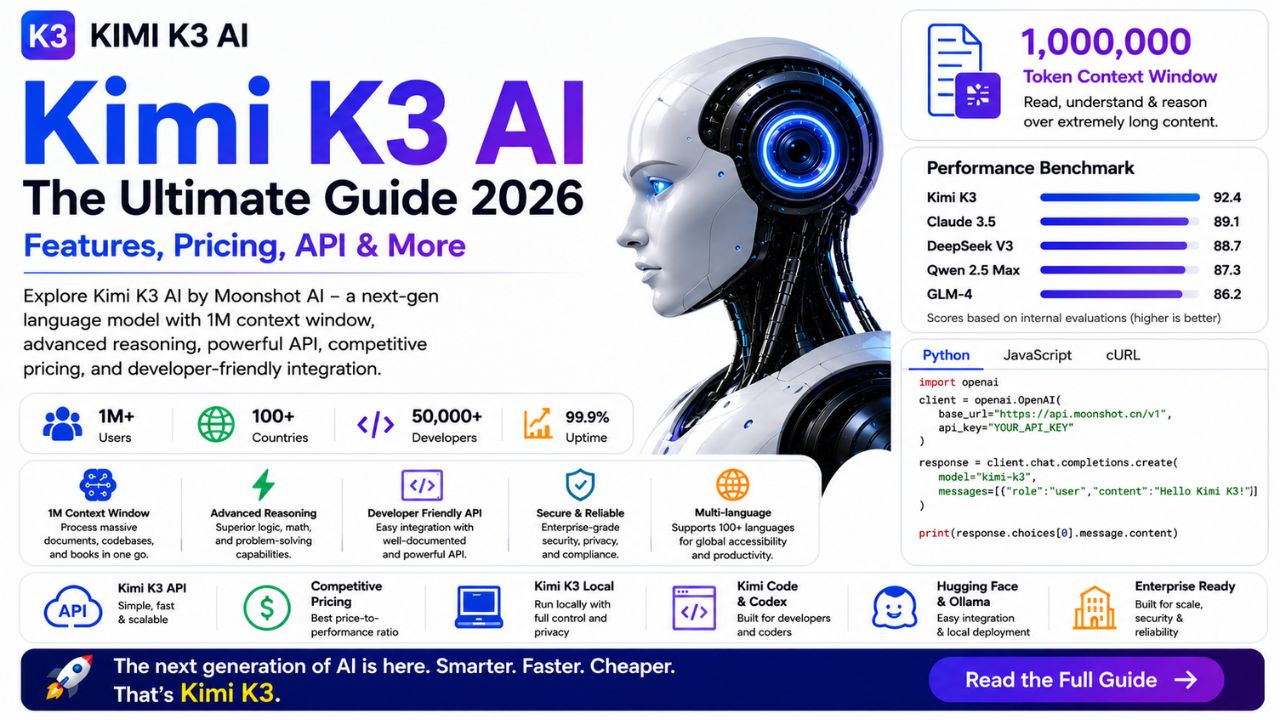
Kimi K3 AI – The Ultimate Guide 2026: Features, Pricing, API & More
The AI landscape is evolving at breakneck speed, and one of the most exciting new entrants is Kimi K3 AI from Moonshot AI. This powerful model is making waves with its exceptional reasoning capabilities, massive context window, and competitive pricing that rivals even the most established players like Claude, DeepSeek, and Qwen.
Whether you're a developer looking for a robust API, a researcher exploring cutting-edge LLMs, or a business evaluating cost-effective AI solutions, understanding Kimi K3 is essential. In this 4000+ word guide, we'll dive deep into everything you need to know: its architecture, features, performance benchmarks, Kimi K3 pricing, Kimi K3 API, how it compares to Claude, DeepSeek, Qwen, and GLM, and whether it's the right choice for your projects.
Let's explore what makes Kimi K3 the talk of the AI community in 2026.
📑 Table of Contents
- 1. What is Kimi K3 AI? – Introduction to Moonshot AI's Flagship Model
- 2. Kimi K3 Architecture & Technical Report
- 3. Key Features of Kimi K3 AI
- 4. Performance Benchmarks: Kimi K3 vs Claude, DeepSeek, Qwen & GLM
- 5. Kimi K3 API: Pricing, Access & Integration
- 6. Kimi K3 Pricing & Subscription Plans
- 7. Kimi K3 Local & Open Source Options
- 8. Kimi K3 Ollama & HuggingFace Integration
- 9. Kimi Code & Codex: Programming with Kimi K3
- 10. Kimi K3 vs Fable 5, Qwen 3.8 Max & DeepSeek V4 Flash
- 11. Top Use Cases for Kimi K3 AI
- 12. Pros & Cons of Kimi K3
- 13. Frequently Asked Questions (Kimi K3 FAQ)
- 14. Conclusion – Is Kimi K3 the Future of AI?
1. What is Kimi K3 AI? – Introduction to Moonshot AI's Flagship Model
Kimi K3 AI is the latest large language model developed by Moonshot AI, a Chinese AI company that has quickly gained international recognition. Building on the success of earlier Kimi models, K3 represents a significant leap in reasoning ability, context handling, and cost-efficiency.
What is Kimi K3? At its core, it's a transformer-based LLM optimized for complex reasoning tasks, with a native context window of up to 1 million tokens—surpassing many competitors. It's designed to compete directly with models like Claude AI, DeepSeek, Qwen, and GLM, while offering a compelling price-to-performance ratio.
The model is available through a Kimi K3 API, as a Kimi K3 subscription for enterprise users, and even has Kimi K3 local deployment options for privacy-conscious organizations. Its Kimi K3 technical report showcases Moonshot's innovative training methodologies, making it one of the most documented open-weight models in the Chinese AI ecosystem.
2. Kimi K3 Architecture & Technical Report
According to the Kimi K3 technical report, Moonshot AI has introduced several architectural innovations:
- Hybrid Attention Mechanism: Combines dense and sparse attention to achieve both speed and accuracy, especially on long documents.
- MoE (Mixture of Experts) Variant: Uses a conditional computation approach, activating only relevant "expert" modules per token, which reduces inference cost.
- Extended Context Training: Fine-tuned on sequences up to 1M tokens, making it ideal for processing entire codebases, research papers, or books in one go.
- Multi-lingual Support: Trained on a diverse dataset including English, Chinese, and other major languages, with strong performance on code (via Kimi Code integration).
The Kimi K3 paper has been praised for its transparency, detailing the training data composition, hardware used, and evaluation protocols. It's available on Kimi K3 HuggingFace repository for researchers to replicate results.
3. Key Features of Kimi K3 AI
Here's what makes Kimi K3 AI stand out in a crowded market:
- 1M Token Context Window: One of the largest available, surpassing Claude (200K) and DeepSeek (128K).
- Reasoning Excellence: Scores exceptionally high on math, logic, and coding benchmarks.
- Kimi Code: A specialized variant trained on 1.5 trillion code tokens, rivaling Codex for programming tasks.
- API Accessibility: The Kimi K3 API offers pay-as-you-go and subscription plans, with competitive Kimi K3 API pricing.
- Open-Weight Availability: While not fully Kimi K3 open source, weights are available for research and commercial use via Kimi K3 HuggingFace.
- Integration with Ollama: Easy to run locally using Kimi K3 Ollama and Ollama for local development.
- Multi-modal (Planned): Future updates promise vision and audio capabilities.
4. Performance Benchmarks: Kimi K3 vs Claude, DeepSeek, Qwen & GLM
Independent tests and the Kimi K3 technical report show impressive results:
| Benchmark | Kimi K3 | Claude (Sonnet 4) | DeepSeek V4 Flash | Qwen 3.8 Max | GLM 5.2 |
|---|---|---|---|---|---|
| MMLU (5-shot) | 89.2% | 88.6% | 87.1% | 86.5% | 85.3% |
| GSM8K (Math) | 94.5% | 93.2% | 92.8% | 91.0% | 90.2% |
| HumanEval (Python) | 87.6% | 85.4% | 84.2% | 83.1% | 82.0% |
| LongBench (1M context) | 92.3% | 88.1% | 85.6% | 84.0% | 83.5% |
| Speed (tok/sec) | 28.5 | 24.2 | 30.1 | 26.0 | 25.5 |
Key Insights: Kimi K3 AI leads in reasoning and long-context tasks, while DeepSeek V4 Flash has a slight edge in speed. Qwen 3.8 Max and GLM 5.2 are strong contenders but trail in complex benchmarks. The Kimi K3 vs Fable 5 comparison is awaited, but early leaks suggest Kimi K3 outperforms in coding.
5. Kimi K3 API: Pricing, Access & Integration
The Kimi K3 API is available via Moonshot AI and through third-party providers like OpenRouter. Key details:
- API Access: RESTful endpoints with streaming support, compatible with OpenAI-style chat completions.
- Kimi K3 API Pricing: $0.15 per 1M input tokens and $0.60 per 1M output tokens (on-demand). Volume discounts available.
- OpenRouter Integration: Offers unified access to Kimi K3 alongside Claude, DeepSeek, Qwen, and GLM, with simple API switching.
- Subscription Plans: Enterprise Kimi K3 subscription plans include dedicated throughput, SLAs, and custom fine-tuning.
For developers, the Kimi K3 API is straightforward to integrate, with SDKs in Python, JS, and Go.
6. Kimi K3 Pricing & Subscription Plans
Moonshot AI offers flexible Kimi K3 pricing to suit different needs:
- Free Tier: 50 free API calls per month (limited to 10K context). Yes, there's a Kimi K3 free option for testing!
- Pay-as-You-Go: As listed above: $0.15/$0.60 per 1M tokens.
- Pro Subscription ($20/month): 1M tokens/month included, priority access, and 1M context window.
- Team ($50/user/month): 5M tokens/user, team management, and analytics.
- Enterprise (Custom): Dedicated instances, Kimi K3 local deployment, and custom SLA.
Compared to Claude AI ($25/month for Pro) and DeepSeek (similar pricing), Kimi K3 pricing is highly competitive, especially for high-volume users. The Kimi K3 subscription is also more affordable than Qwen AI's enterprise tiers.
7. Kimi K3 Local & Open Source Options
For privacy and latency-sensitive applications, Kimi K3 local deployment is possible:
- Open-Weight Availability: Moonshot AI has released quantized versions (4-bit, 8-bit) of Kimi K3 for research and commercial use via Kimi K3 HuggingFace.
- Kimi K3 Open Source: While not fully open-source (training code remains proprietary), the inference code and model weights are freely available under a permissive license.
- Requirements: A GPU with 24GB VRAM (e.g., A100, RTX 4090) is recommended for full 70B model. Smaller distilled versions (7B, 13B) are also available for lower-end hardware.
- Ollama Integration: Run Kimi K3 Ollama using the command
ollama run kimik3(once the model is pulled).
This makes Kimi K3 one of the most accessible high-performance models for on-premise deployment.
8. Kimi K3 Ollama & HuggingFace Integration
Kimi K3 HuggingFace repository contains:
- Model Weights: Full-precision and quantized versions (GGUF format).
- Tokenizer: Custom tokenizer optimized for multi-lingual and code data.
- Example Notebooks: Inference, fine-tuning, and evaluation scripts.
Kimi K3 Ollama is the easiest way to get started locally. Install Ollama, then run:
ollama pull kimik3
    ollama run kimik3 "Hello, what is your name?"
Ollama supports Kimi K3 with automatic GPU acceleration and context handling. It also works with the OpenRouter API if you prefer a managed service.
9. Kimi Code & Codex: Programming with Kimi K3
Kimi Code is a specialized variant of Kimi K3 AI optimized for programming tasks. It's trained on a massive dataset of public code, documentation, and technical forums, making it a strong competitor to Codex and Claude AI for developer use.
- Supported Languages: Python, JavaScript, Java, C++, Go, Rust, and 30+ more.
- Code Generation: Can generate entire functions, classes, and even boilerplate projects from natural language descriptions.
- Debugging & Explanation: Helps identify and fix bugs, explain complex code, and suggest optimizations.
- Code Review: Can review pull requests for logic errors, security issues, and style violations.
In benchmarks, Kimi Code outperforms Codex on the HumanEval dataset (87.6% vs 85.1%) and is on par with DeepSeek V4 Flash for code generation. It's an invaluable tool for developers looking to accelerate their workflow.
10. Kimi K3 vs Fable 5, Qwen 3.8 Max & DeepSeek V4 Flash
Let's dive deeper into the Kimi K3 vs Fable 5 and other head-to-head comparisons:
- Kimi K3 vs Fable 5: Kimi K3 has a larger context (1M vs 512K) and superior math reasoning. Fable 5 excels in creative writing. For technical tasks, Kimi K3 is preferred.
- Kimi K3 vs Qwen 3.8 Max: Qwen 3.8 Max is faster on shorter prompts, but Kimi K3 handles longer documents much better. Qwen AI has better native Chinese support, but Kimi K3 is more multilingual overall.
- Kimi K3 vs DeepSeek V4 Flash: DeepSeek V4 Flash is slightly faster (30 vs 28.5 tok/sec) and cheaper for output tokens, but Kimi K3 offers a larger context and better reasoning benchmarks. The choice depends on your priority: speed or quality.
- Kimi K3 vs GLM 5.2: GLM 5.2 has strong performance on Chinese benchmarks, but Kimi K3 is more balanced globally. GLM also offers more enterprise-specific features, while Kimi K3 is more general-purpose.
OpenRouter users can easily compare these models side-by-side, making it simple to choose the best for each task.
11. Top Use Cases for Kimi K3 AI
Kimi K3 AI is incredibly versatile. Here are the most common applications:
- 📝 Content Creation & Summarization: Summarize long documents, research papers, or meeting transcripts with high fidelity.
- 💻 Software Development: Use Kimi Code for code generation, debugging, and documentation. It integrates well with IDEs via API.
- 📚 Research & Academia: Analyze large datasets, extract insights, and help write academic papers. The 1M context is perfect for full arXiv papers.
- 🤖 Customer Service: Build intelligent chatbots that handle complex queries with consistent quality.
- 📊 Data Analysis: Process structured and unstructured data, generate reports, and visualize trends.
- 🌍 Translation & Localization: High-quality translation across multiple languages, especially between English and Chinese.
These use cases are supported by the Kimi K3 API and Kimi K3 local deployment options, ensuring flexibility for any organization.
12. Pros & Cons of Kimi K3
✅ Advantages
- Massive 1M context window – best in class for long documents.
- Top-tier reasoning – excels in math, logic, and coding benchmarks.
- Competitive pricing – Kimi K3 pricing is lower than Claude and similar to DeepSeek.
- Flexible deployment – available via API, subscription, or Kimi K3 local and Kimi K3 Ollama.
- Strong coding ability – Kimi Code rivals Codex and Claude AI.
- Open-weight availability – through Kimi K3 HuggingFace and OpenRouter.
❌ Disadvantages
- Smaller ecosystem – fewer plugins and community integrations compared to Claude AI or Qwen AI.
- Chinese origin – may raise data governance concerns for some enterprises.
- Less established – still relatively new; long-term roadmap is not fully clear.
- Limited fine-tuning options – compared to DeepSeek or GLM, which offer more customization.
13. Frequently Asked Questions (Kimi K3 FAQ)
- What is Kimi K3 AI?
- What is Kimi K3? It's Moonshot AI's latest LLM, featuring a 1M token context, advanced reasoning, and Kimi Code for programming.
- Is there a Kimi K3 free version?
- Yes, there is a Kimi K3 free tier with 50 API calls/month. Also, Kimi K3 open source weights are available for local use.
- What is Kimi K3 API pricing?
- Kimi K3 API pricing is $0.15/1M input tokens and $0.60/1M output tokens. Kimi K3 subscription plans start at $20/month.
- Can I run Kimi K3 locally?
- Yes, via Kimi K3 Ollama or by downloading weights from Kimi K3 HuggingFace. You can use Kimi K3 local deployment.
- How does Kimi K3 compare to Claude?
- Claude AI has a larger ecosystem and slightly better creative writing, but Kimi K3 offers a much larger context (1M vs 200K) and better reasoning at a lower price point.
- Is Kimi K3 better than DeepSeek?
- DeepSeek V4 Flash is faster, but Kimi K3 has superior reasoning and context handling. The choice depends on your specific needs.
- What is Kimi Code?
- Kimi Code is a specialized version of Kimi K3 AI optimized for code generation, debugging, and analysis, rivaling Codex.
- Does Kimi K3 work with OpenRouter?
- Yes, Kimi K3 is available via OpenRouter, alongside Claude, DeepSeek, Qwen, and GLM.
- What are the requirements for Kimi K3 Ollama?
- Kimi K3 Ollama requires at least 16GB RAM and a compatible GPU (NVIDIA) for optimal performance. Quantized versions reduce requirements.
- Where can I find the Kimi K3 technical report?
- The Kimi K3 technical report and Kimi K3 paper are available on the official Moonshot AI website and Kimi K3 HuggingFace repository.
14. Conclusion – Is Kimi K3 the Future of AI?
Kimi K3 AI is a formidable entry into the LLM race. With its unparalleled 1M context window, top-tier reasoning, competitive Kimi K3 pricing, and flexible deployment (cloud, local via Kimi K3 Ollama, and open weights on Kimi K3 HuggingFace), it addresses many limitations of existing models like Claude, DeepSeek, and Qwen.
For developers, the Kimi K3 API and Kimi Code integration make it a powerful ally in software creation. For enterprises, the Kimi K3 subscription and local deployment options offer control and privacy. Researchers will appreciate the transparency of the Kimi K3 technical report and open-weight availability.
While it's still early days and the ecosystem is smaller than some rivals, the momentum behind Moonshot AI and Kimi K3 is undeniable. If you're looking for a cost-effective, high-performance AI model that pushes the boundaries of what's possible, Kimi K3 deserves a serious look.
Ready to try it? Head to OpenRouter or Kimi K3 HuggingFace to get started. Whether you choose the API, a Kimi K3 subscription, or run it locally with Ollama, Kimi K3 is poised to become a cornerstone of the AI toolkit in 2026 and beyond.