
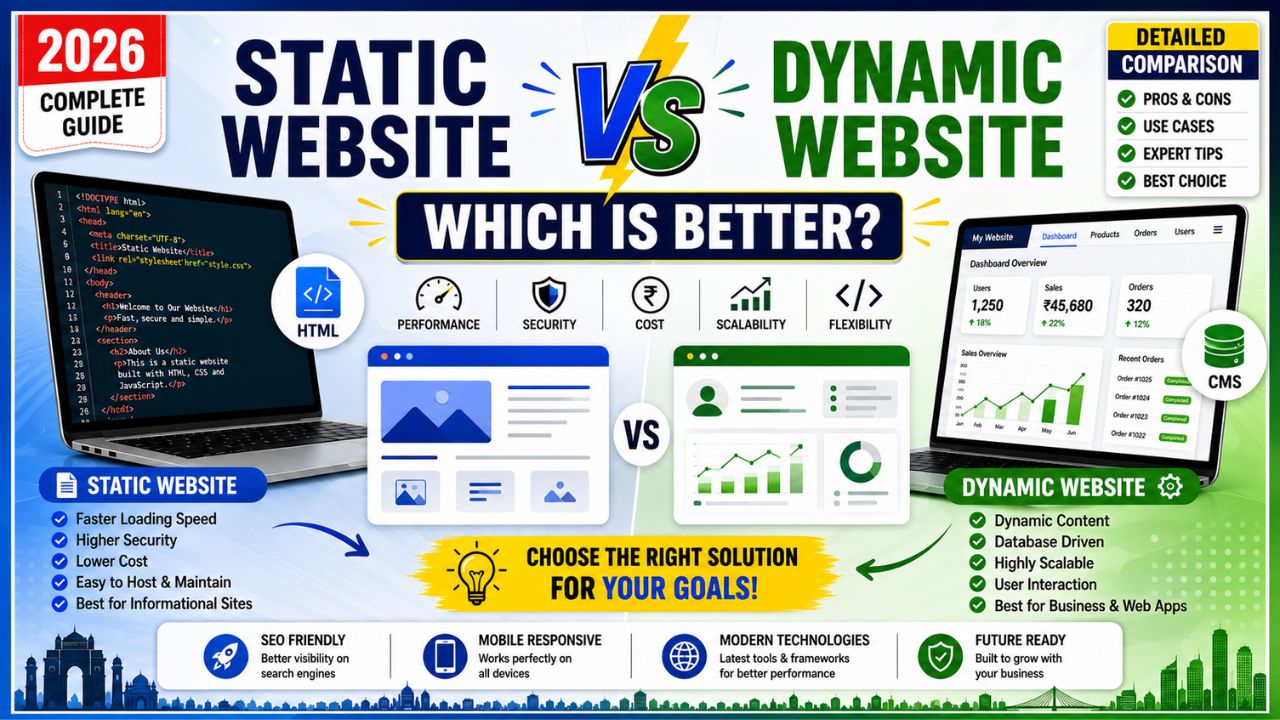
Static Website vs Dynamic Website – Which is Better?
One of the most common dilemmas businesses face when planning a new website is: should I build a static site or a dynamic one? The choice impacts performance, cost, scalability, and maintenance. In this blog, we break down the differences, strengths, and weaknesses of each approach, so you can make the right decision for your project.
We'll cover everything from technology, use cases, SEO, security, and budget – with a special focus on the Indian development landscape.
📑 Table of Contents
- 1. What is a Static Website?
- 2. What is a Dynamic Website?
- 3. Side‑by‑Side Comparison
- 4. Pros & Cons at a Glance
- 5. When to Choose Static vs Dynamic
- 6. Cost Implications in India
- 7. SEO & Performance Impact
- 8. Security Considerations
- 9. The Hybrid Approach (JAMstack / Headless)
- 10. FAQ
- 11. Conclusion
1. What is a Static Website?
A static website consists of fixed content – each page is a separate HTML file that is delivered exactly as stored. There is no server‑side processing; the browser receives the same file every time. These sites are typically built with HTML, CSS, and JavaScript (client‑side).
Common examples: Brochure sites, landing pages, portfolio pages, documentation, and small business websites.
Key characteristics: Fast loading, simple hosting, low cost, and easy to deploy. Content updates require manual editing of HTML files (or using a static site generator).
2. What is a Dynamic Website?
A dynamic website generates content in real‑time based on user interactions, database queries, or other parameters. Pages are assembled on the server (or client‑side with frameworks) using languages like PHP, Python, Node.js, or Ruby, and they pull data from a database.
Common examples: E‑commerce stores, social networks, dashboards, membership portals, and CMS‑driven sites (WordPress, Drupal).
Key characteristics: Interactive, personalised, scalable, but more complex and expensive to build and maintain.
3. Side‑by‑Side Comparison
| Feature | Static Website | Dynamic Website |
|---|---|---|
| Content delivery | Pre‑built HTML files | Generated on‑the‑fly |
| Performance | Very fast (no server processing) | Slower (requires DB queries & rendering) |
| Hosting cost | Low (cheap CDN / static hosting) | Higher (needs server resources, DB) |
| Development cost (India) | ₹15,000 – ₹60,000 | ₹50,000 – ₹5,00,000+ |
| Maintenance | Minimal | Regular updates, security patches |
| Scalability | Excellent (CDN caching) | Requires optimisation, load balancing |
| Interactivity | Limited (client‑side JS only) | Full user interaction, personalisation |
| CMS / editable | Usually via static site generators | Built‑in admin panels (e.g., WordPress) |
4. Pros & Cons at a Glance
✅ Static Website – Advantages
- Lightning‑fast page load (ideal for Core Web Vitals).
- Extremely secure (no database or server‑side vulnerabilities).
- Very low hosting costs (can even be hosted on free CDN platforms).
- Simple to build and deploy (good for small teams).
❌ Static Website – Disadvantages
- Content updates require rebuilding and re‑deploying.
- No user‑specific content (everyone sees the same page).
- Limited interactivity (though JavaScript can add some).
✅ Dynamic Website – Advantages
- Personalised content, user logins, and complex features.
- Easy content management via CMS (non‑technical users).
- Scalable for large data and high traffic (with proper architecture).
- Better for e‑commerce, social, and community sites.
❌ Dynamic Website – Disadvantages
- Higher development and hosting costs.
- More attack surface (SQL injection, XSS, etc.).
- Requires regular maintenance and updates.
- Slower if not optimised (caching, CDN needed).
5. When to Choose Static vs Dynamic
Choose a static website if:
- You need a simple brochure, portfolio, or landing page.
- Content changes infrequently (e.g., company info, contact).
- You have a tight budget and want maximum performance.
- You're building a documentation site or a blog with few authors.
Choose a dynamic website if:
- You're building an e‑commerce store, marketplace, or SaaS.
- Users need to log in, create profiles, or interact with each other.
- Content is updated daily by multiple editors (CMS required).
- You need personalisation, recommendations, or real‑time data.
6. Cost Implications in India
India's development market offers competitive rates for both static and dynamic projects. Here's a rough estimate (₹ INR) based on agency/freelancer quotes in 2026:
| Project Type | Static (₹) | Dynamic (₹) |
|---|---|---|
| Basic business site (5‑10 pages) | 15,000 – 40,000 | 40,000 – 1,20,000 |
| CMS‑driven (WordPress / custom) | — (not typical) | 50,000 – 2,50,000 |
| E‑commerce (up to 100 products) | — | 80,000 – 4,00,000 |
| Custom web app (SaaS / portal) | — | 2,00,000 – 15,00,000+ |
Hosting: Static sites can be hosted on Netlify/Vercel for free or ₹500‑₹2,000/month. Dynamic hosting (with database) starts at ₹1,500/month and goes up significantly for enterprise.
7. SEO & Performance Impact
Google and other search engines prioritise fast, mobile‑friendly sites. Static websites have a clear advantage here – they load instantly, and their HTML is easily crawlable. With dynamic sites, you need to implement caching, CDN, and optimisation to match static performance.
- Core Web Vitals: Static sites generally score excellent in LCP, FID, and CLS.
- Crawl budget: Dynamic sites with many pages may need careful URL structuring and sitemaps.
- SEO flexibility: Both can be optimised, but static sites are simpler to audit.
That said, dynamic CMS platforms (like WordPress) offer powerful SEO plugins, which can be a plus for non‑technical marketers.
8. Security Considerations
Static websites are inherently more secure because there's no server‑side code or database to exploit. The only risks are client‑side (XSS) or CDN misconfigurations, which are easier to mitigate.
Dynamic websites face a wider threat landscape: SQL injection, cross‑site scripting, brute‑force attacks, and plugin vulnerabilities (in CMS). In India, security audits and hardening services add to the cost but are essential for e‑commerce and user‑data handling.
Recommendation: If you handle sensitive user data, invest in a dynamic solution with robust security practices. For informational sites, static is the safer bet.
9. The Hybrid Approach (JAMstack / Headless)
In recent years, the JAMstack architecture has gained popularity, offering a middle ground: you get the speed and security of static sites with the dynamic capabilities of APIs. Content is managed via a headless CMS (e.g., Contentful, Sanity) and served as static files, while dynamic features are handled by third‑party services or serverless functions.
This approach is increasingly popular in India for mid‑sized projects that need both performance and flexibility. Development costs are moderate, and hosting via CDN is highly efficient.
Examples: Next.js with headless WordPress, Gatsby, or Hugo.
10. Frequently Asked Questions
- Which is better for SEO – static or dynamic?
- Both can rank well, but static sites have a performance advantage. Dynamic sites need optimisation (caching, fast hosting) to match.
- Can I convert a static site to dynamic later?
- Yes, but it's a significant re‑engineering. It's better to plan ahead based on your long‑term needs.
- Is WordPress static or dynamic?
- WordPress is dynamic by default (PHP + MySQL). However, with caching and static plugins, you can make it behave like a static site.
- What is cheaper to develop in India?
- Static sites are significantly cheaper – up to 60‑70% less than a feature‑rich dynamic site.
- Which is more secure?
- Static sites are more secure out‑of‑the‑box because there's no server‑side code or database.
- Can a dynamic site be fast?
- Yes, with proper caching, CDN, database optimisation, and modern frameworks (like Next.js or Laravel).
11. Conclusion – Which One is Better?
The answer is: it depends on your goals. There's no universal "better" – it's about what fits your business, budget, and technical capacity.
- Choose static if you want speed, security, low cost, and simple content.
- Choose dynamic if you need interactivity, user management, e‑commerce, or frequent content updates.
- Consider hybrid (JAMstack) for the best of both worlds – static delivery with dynamic features via APIs.
In the Indian context, static sites are ideal for startups and small businesses, while dynamic sites are preferred for growing businesses that need scalability. Assess your requirements carefully, and don't hesitate to consult with developers to map out the right architecture.
Still unsure? Start with a static MVP and add dynamic features as you grow – many successful companies have taken this path.