Ghostface Website – AI Voice Cloning & Meme Culture
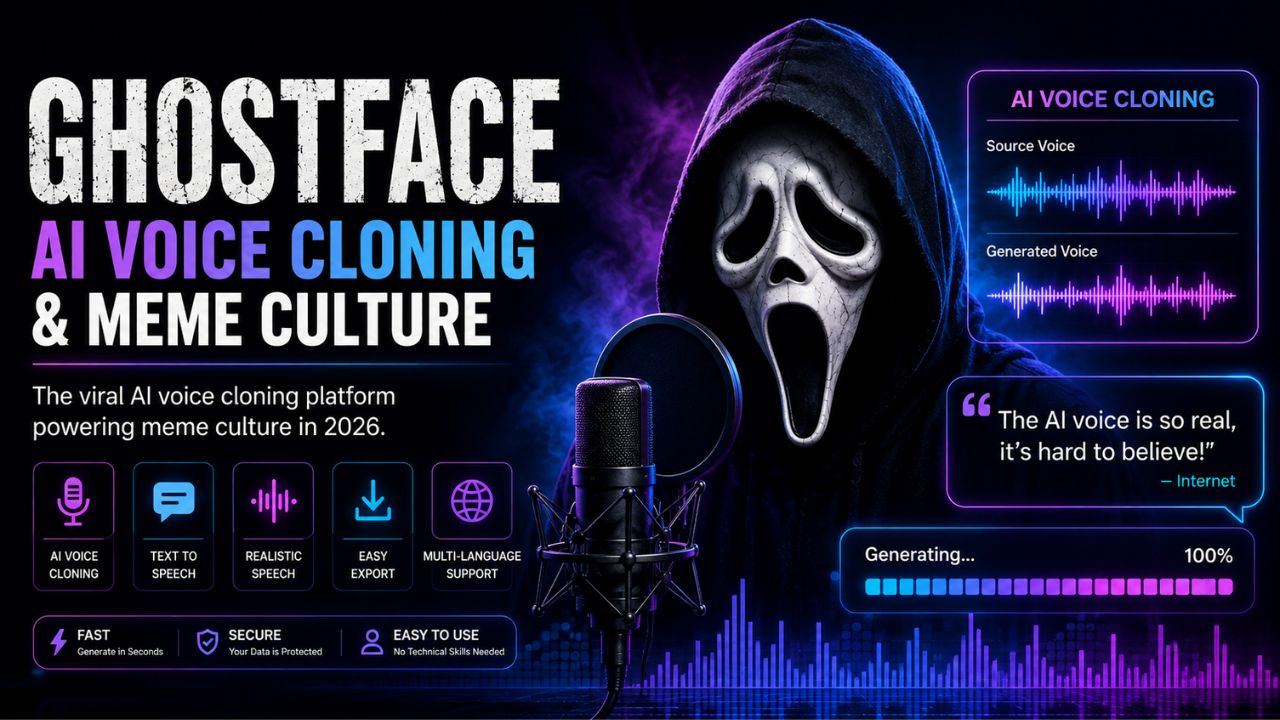
In the ever-evolving world of AI, few tools have captured the internet's imagination quite like the Ghostface website. If you've been on social media recently, you've likely heard viral audio clips of celebrities, politicians, or characters saying things they never actually said—all generated by AI.
The Ghostface platform is one of the most popular and accessible AI voice cloning tools, allowing users to create realistic speech deepfakes with just a few clicks. But what exactly is Ghostface? How does it work? Is it legal? And is it safe to use?
In this comprehensive guide, we'll explore everything you need to know about the Ghostface website, its features, its impact on meme culture, the ethical concerns surrounding it, and how it compares to other AI voice tools.
📑 Table of Contents
- 1. What is the Ghostface Website?
- 2. Key Features of Ghostface
- 3. How Ghostface AI Voice Cloning Works
- 4. Popular Use Cases & Meme Culture
- 5. Ghostface vs Other AI Voice Tools
- 6. Ethical & Legal Considerations
- 7. Is Ghostface Safe? Privacy & Security
- 8. Pricing & Plans
- 9. The Future of AI Voice Cloning
- 10. Frequently Asked Questions
- 11. Conclusion – The Impact of Ghostface
1. What is the Ghostface Website?
Ghostface is an AI-powered voice cloning platform that enables users to generate synthetic speech in the voice of any person—celebrity, politician, fictional character, or even themselves—using just a short audio sample.
Named after the iconic mask from the "Scream" franchise, the Ghostface website taps into the viral nature of meme culture. It became particularly popular in late 2025 and early 2026, as AI voice technology reached a level of realism where it became difficult for the average listener to distinguish between real and AI-generated audio.
The platform is web-based, requiring no software installation, and offers a straightforward interface: upload a voice sample, type the text you want the voice to say, and within seconds, you have a high-quality AI-generated audio file ready to download and share.
2. Key Features of Ghostface
Ghostface offers a surprisingly robust set of features for a browser-based tool:
- 🎤 Instant Voice Cloning: Clone any voice with just 5-10 seconds of clean audio. The AI captures tone, pitch, accent, and emotional nuance.
- 📝 Text-to-Speech (TTS): Type or paste any text, and Ghostface will generate a realistic voice-over in the cloned voice.
- 🎭 Celebrity & Character Presets: Ghostface provides a library of pre-cloned voices (with varying degrees of accuracy), including famous actors, politicians, and cartoon characters.
- 🌍 Multi-Language Support: Works with dozens of languages, including English, Spanish, Mandarin, Hindi, and more.
- 🔊 Emotion Control: Users can adjust the emotional tone—happy, sad, angry, sarcastic—to make the delivery feel more authentic.
- 📥 Easy Export: Download generated audio as MP3, WAV, or OGG files.
- 🔗 Shareable Links: Generate a shareable URL for your creations, making it easy to post on social media.
3. How Ghostface AI Voice Cloning Works
Under the hood, Ghostface uses a combination of deep learning models:
- Speaker Encoder: When you upload a voice sample, Ghostface uses a speaker encoder (often based on models like VoxCeleb or ResNet) to extract a unique "voice fingerprint" or embedding that captures the distinctive characteristics of the voice.
- Acoustic Model: The text you provide is processed by an acoustic model (often a variant of Tacotron or FastSpeech) to generate a mel-spectrogram—a visual representation of the sound—that matches the text in the target voice.
- Vocoder: Finally, a neural vocoder (like WaveRNN or HiFi-GAN) converts the mel-spectrogram back into a raw audio waveform, producing the final, realistic-sounding audio.
The entire process takes only a few seconds, thanks to optimized inference on GPU-powered servers. Ghostface's secret sauce is the fine-tuning on a massive dataset of diverse voices, enabling it to generalize to new voices with minimal input.
4. Popular Use Cases & Meme Culture
Ghostface has become a phenomenon in meme culture. Here are the most common ways people are using it:
- 🎶 Viral Parodies: Users have created hilarious clips of celebrities saying ridiculous things, politicians endorsing silly products, and characters from movies narrating mundane tasks.
- 📱 Social Media Content: TikTok, Instagram Reels, and YouTube Shorts are flooded with Ghostface-generated audio. The ability to make any voice say anything is a meme creator's dream.
- 🎮 Gaming & Livestreaming: Streamers use Ghostface to add voiceovers to gameplay highlights or to create funny interactions between characters.
- 📚 Audiobooks & Narration: Some users have experimented with creating audiobooks in the voices of famous actors—though this treads into copyright gray areas.
- 🤖 Personal Assistants: Power users have cloned their own voices to create custom TTS for smart home devices or video projects.
The platform's accessibility has lowered the barrier to entry for voice-based content creation, but it has also opened a Pandora's box of ethical issues.
5. Ghostface vs Other AI Voice Tools
How does Ghostface stack up against the competition?
| Feature | Ghostface | ElevenLabs | Resemble AI | Play.ht |
|---|---|---|---|---|
| Ease of Use | ⭐⭐⭐⭐⭐ (Very Easy) | ⭐⭐⭐⭐ | ⭐⭐⭐ | ⭐⭐⭐⭐ |
| Voice Quality | ⭐⭐⭐⭐ (Very Realistic) | ⭐⭐⭐⭐⭐ (Best-in-Class) | ⭐⭐⭐⭐ | ⭐⭐⭐ |
| Free Tier | ✅ (Limited) | ✅ (Limited) | ❌ (Trial only) | ✅ (Limited) |
| Celebrity Voices | ✅ (Pre-built library) | ❌ (No pre-built) | ❌ | ❌ |
| Emotion Control | ✅ | ✅ | ✅ | ❌ |
| Pricing (Monthly) | $12 (Pro) | $22 (Starter) | $29 (Basic) | $19 (Pro) |
Key Takeaway: Ghostface is the most user-friendly and meme-friendly option, with a strong focus on viral content. ElevenLabs offers superior voice quality and is better for professional applications. Resemble AI is more enterprise-focused, and Play.ht is a solid all-rounder.
6. Ethical & Legal Considerations
This is where Ghostface gets controversial. The ability to clone any voice has profound implications:
- Consent: Cloning a person's voice without their permission is a violation of their likeness rights in many jurisdictions. Celebrities, in particular, have been vocal about unauthorized use of their voices.
- Misinformation: Deepfake audio can be used to spread disinformation. Imagine a convincing audio clip of a world leader announcing a false policy—it could cause real-world chaos.
- Fraud & Scams: Voice cloning has already been used in "CEO fraud" scams, where attackers impersonate a company executive to authorize wire transfers.
- Copyright & Intellectual Property: Using a character's voice (e.g., Mickey Mouse or Darth Vader) for commercial purposes without a license is a copyright violation.
Ghostface's Response: The platform includes a disclaimer that users must obtain permission before cloning any voice and prohibits using the tool for malicious purposes. However, enforcement is challenging, and the sheer volume of generated clips makes it difficult to police.
7. Is Ghostface Safe? Privacy & Security
From a data privacy perspective, Ghostface claims to collect minimal data. According to their privacy policy:
- Uploaded voice samples are used only to generate the requested audio and are then deleted from their servers.
- Generated audio files are stored temporarily (for sharing links) but can be deleted by the user at any time.
- No personally identifiable information (PII) is required to use the basic service.
However, there are concerns about voice data being used to improve the AI model (similar to how ChatGPT trains on user conversations). Ghostface does not explicitly state that it doesn't use your data for training, so if you're privacy-conscious, you should read the terms carefully.
Security: The platform uses HTTPS encryption, but as with any online tool, there's always a risk of data breaches. It's advisable not to upload highly sensitive or private voice recordings.
8. Pricing & Plans
As of 2026, Ghostface offers the following plans:
- Free Plan: 5 free voice generations, limited to 10-second clips. No commercial use.
- Pro Plan ($12/month): Up to 100 generations/month, 60-second clips, commercial license for personal projects.
- Creator Plan ($29/month): Up to 500 generations/month, 120-second clips, priority processing, full commercial rights.
- Enterprise Plan (Custom): Unlimited generations, custom models, API access, and dedicated support.
Annual subscriptions offer a 25% discount. The free tier is a great way to test the tool, but for serious meme creators, the Pro plan offers the best value.
9. The Future of AI Voice Cloning
Ghostface is riding the wave of a larger trend. Here's what we can expect in the coming years:
- Regulation: Governments are already drafting laws to require watermarks or digital signatures on AI-generated content. Ghostface may be forced to adopt such measures.
- Real-Time Cloning: Real-time voice cloning for live streaming and phone calls is on the horizon, raising even more fraud concerns.
- Better Detection: As deepfakes get better, so will detection tools. Platforms like Ghostface will need to balance creativity with accountability.
- Niche Expansion: Beyond memes, voice cloning will revolutionize audiobooks, dubbing, and personalized advertising.
Ghostface is well-positioned to be a leader in the consumer-facing voice AI space, but it will have to navigate a minefield of ethical and legal challenges.
10. Frequently Asked Questions
- Is the Ghostface website free to use?
- Yes, there is a limited free tier. For more extensive use, paid plans start at $12/month.
- Can I use Ghostface to clone any voice?
- Theoretically, yes. But you should obtain permission from the person whose voice you're cloning, especially for public or commercial use.
- Is Ghostface legal?
- The tool itself is legal, but the way you use it may not be. Creating deepfakes for harassment, fraud, or spreading misinformation is illegal in many countries.
- How accurate is Ghostface voice cloning?
- It's very realistic for common voices with clear audio samples. It may struggle with heavy accents, background noise, or highly emotional speech.
- Can I delete my voice data from Ghostface?
- Yes, you can request deletion of your voice samples and generated clips through the privacy settings or by contacting support.
- Does Ghostface support multiple languages?
- Yes, it supports dozens of languages, including English, Spanish, French, Mandarin, and Hindi.
11. Conclusion – The Impact of Ghostface
The Ghostface website is a testament to the rapid advancement of AI voice technology. It has democratized voice cloning, making it accessible to anyone with an internet connection. The result has been a flood of creative and often hilarious content that has taken social media by storm.
However, with great power comes great responsibility. The same tool that creates memes can also be used to deceive, manipulate, and harm. As users, we must be mindful of the ethical boundaries and use Ghostface—and similar tools—judiciously.
Should you use Ghostface? If you're looking to create fun content, experiment with AI, or even explore voice narration, Ghostface is an excellent, affordable, and easy-to-use platform. Just remember to respect consent, avoid harm, and stay informed about the legal landscape.
AI voice cloning is here to stay. It's up to us to shape its future for the better.