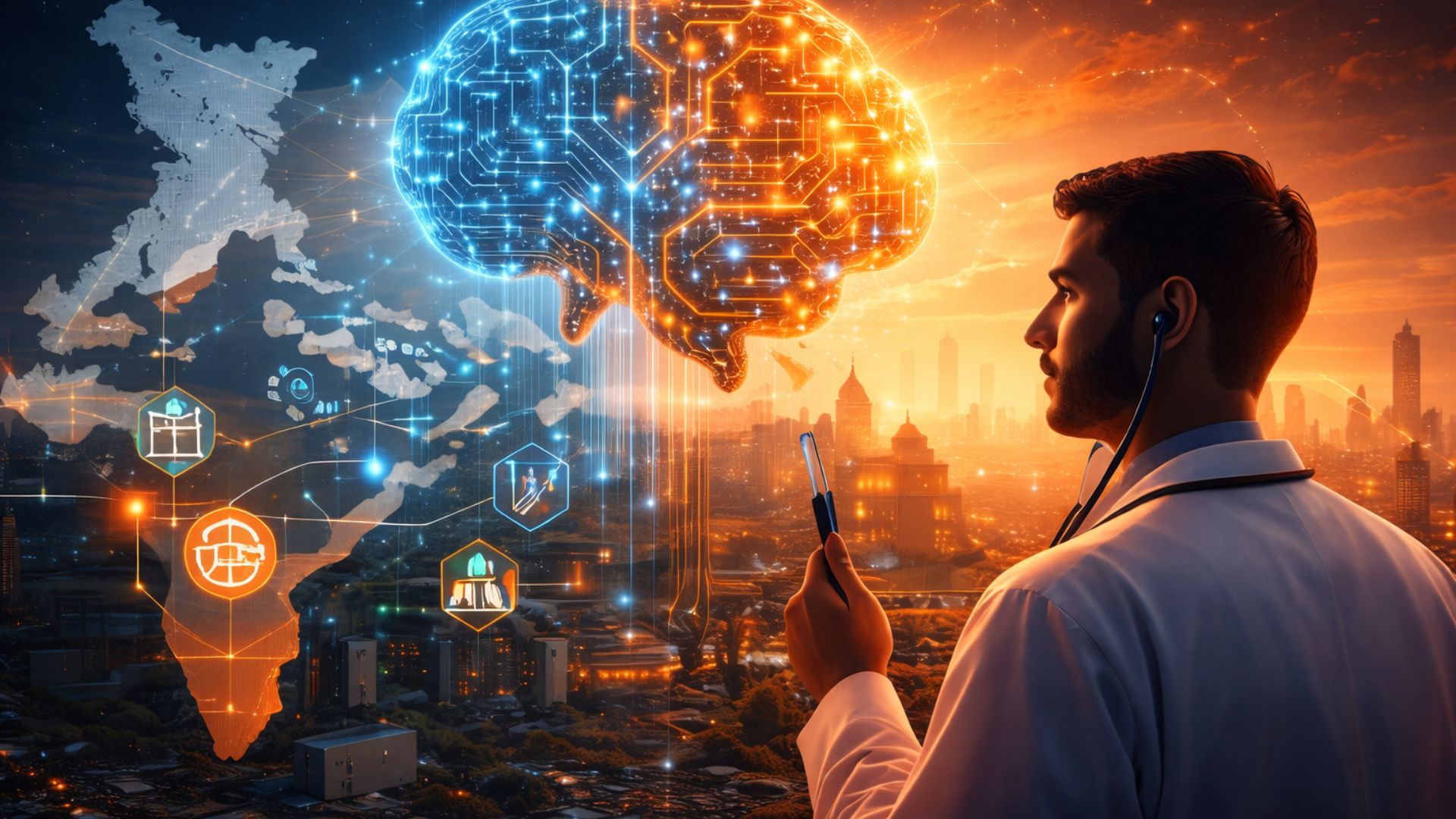
From the ancient stepwells that mastered water conservation to the invention of zero that reshaped global mathematics, India has always stood at the crossroads of knowledge, innovation, and civilization. In the 21st century, as the world enters a new cognitive era powered by Artificial Intelligence (AI), India is once again positioned to play a defining role. AI is no longer a futuristic concept—it is already transforming how Indians live, learn, work, and govern.
The future of Artificial Intelligence in India is not merely about automation or technological dominance; it is about inclusive growth, social transformation, and responsible innovation. With a massive population, diverse languages, large datasets, and a strong digital backbone, India offers a unique testing ground for scalable and ethical AI solutions.
Current State of Artificial Intelligence in India
India’s AI ecosystem has grown rapidly over the past decade. Today, India ranks among the top 10 countries globally in AI adoption, research output, and talent availability. According to NASSCOM, India hosts more than 5,000 AI startups, spanning healthcare, fintech, agritech, education, retail, and governance.
The Indian AI market is projected to reach $7.8 billion by 2025, growing at a CAGR of over 20%. This growth is fueled by rising cloud adoption, affordable computing, government initiatives, and a young, tech-savvy workforce.
- AI Talent Pool: India contributes nearly 16% of the global AI workforce (LinkedIn Economic Graph)
- Research Output: Ranked 5th globally in AI research publications
- Digital Reach: 800+ million internet users (TRAI)
- Startup Growth: 86% year-on-year increase in AI funding
Government Initiatives Powering AI Growth
IndiaAI Mission (2024)
The IndiaAI Mission is India’s most ambitious national AI program, launched with a budget of ₹10,372 crore. Officially supported by the Ministry of Electronics and Information Technology (MeitY), this initiative focuses on strengthening India’s AI infrastructure and innovation ecosystem.
Key components of the IndiaAI Mission include building public AI compute capacity with more than 10,000 GPUs, establishing the IndiaAI Innovation Centre, creating a centralized AI datasets platform, and supporting AI startups with a ₹2,000 crore financing facility.
National Strategy for Artificial Intelligence – AI for All
The NITI Aayog launched the National Strategy for AI with the vision of “AI for All.” The strategy identifies healthcare, agriculture, education, smart cities, and smart mobility as priority sectors where AI can deliver maximum social impact.
Official reports and policy documents can be accessed through the NITI Aayog AI portal.
Digital India Bhashini
India’s linguistic diversity presents both a challenge and an opportunity. The Digital India Bhashini initiative aims to develop multilingual AI models that support all 22 scheduled Indian languages. This enables digital inclusion and ensures that AI benefits reach rural and non-English-speaking populations.
Sector-Wise Applications of AI in India
Healthcare Transformation
AI is revolutionizing healthcare delivery in India by addressing shortages of doctors, improving diagnostic accuracy, and expanding rural access. AI-powered imaging systems are now capable of detecting diseases like oral cancer, breast cancer, and tuberculosis with accuracy exceeding 95%.
Telemedicine platforms supported by AI have reduced patient travel by up to 40%, especially in remote areas. Government health data initiatives via the National Health Portal further strengthen AI-driven public health monitoring.
Agriculture and Rural Development
Agriculture employs nearly 45% of India’s workforce, making AI adoption in this sector critical. AI-powered platforms such as CropIn and DeHaat use satellite imagery, weather data, and machine learning to improve crop yields, optimize irrigation, and reduce input costs.
Precision agriculture solutions have reduced water usage by 35% while increasing productivity by 20%. Government support from the Ministry of Agriculture accelerates AI adoption among small farmers.
Education and Skill Development
AI is reshaping education through personalized learning, adaptive assessments, and skill mapping. Platforms like BYJU’S and government-backed initiatives such as NPTEL offer AI-powered courses accessible nationwide.
Online learning platforms including Coursera and edX help Indian learners acquire future-ready AI and data science skills.
Smart Cities and Governance
AI enables smarter governance through traffic optimization, waste management, public safety, and citizen services. AI-controlled traffic signals have reduced congestion by 20% in major cities. AI chatbots now handle over 70% of routine government queries, significantly reducing response times.
Manufacturing and Industry 4.0
India’s manufacturing sector is embracing AI for predictive maintenance, quality control, and energy optimization. Computer vision systems now detect defects with 99.9% accuracy, while AI-driven predictive analytics reduce machine downtime by nearly 30%.
AI Startup Ecosystem in India
India’s AI startup ecosystem is supported by initiatives like Startup India and industry associations such as IAMAI.
Leading AI startups include Uniphore (conversational AI), Niramai (healthcare diagnostics), and Staqu (video analytics).
Challenges Facing AI Development in India
Despite rapid growth, India faces several challenges in scaling AI adoption. Limited high-performance computing infrastructure, fragmented data ecosystems, and a shortage of industry-ready AI professionals remain significant hurdles.
Data privacy is another critical concern. The Digital Personal Data Protection Act, 2023 establishes a legal foundation for responsible data usage while encouraging innovation.
Ethics and Responsible AI
Responsible AI development is central to India’s strategy. The Responsible AI for All framework emphasizes fairness, transparency, accountability, and human oversight.
Key focus areas include reducing algorithmic bias, ensuring explainability, maintaining human-in-the-loop systems, and conducting regular social impact assessments.
Future Roadmap: 2024–2030
Between 2024 and 2030, India is expected to move from AI adoption to AI leadership. By 2030, AI could contribute nearly $1 trillion to India’s economy and transform over 80% of businesses.
India’s experience with population-scale digital systems like India Stack provides a strong foundation for deploying AI responsibly and affordably across sectors.
Conclusion
The future of Artificial Intelligence in India is deeply intertwined with the nation’s vision of inclusive growth and technological sovereignty. With strong government backing, a massive talent pool, and a vibrant startup ecosystem, India has the potential to become a global hub for ethical, affordable, and scalable AI solutions.
Rather than asking whether AI will shape India’s future, the real question is how effectively India can harness AI to improve lives, empower citizens, and lead the world toward a more human-centric technological future.