Table of Contents
- The AI Revolution Needs a New Engine
- What Makes H100 So Revolutionary?
- Technical Deep Dive: Inside the Beast
- Hopper Architecture: More Than Just Numbers
- Real-World Applications Changing Industries
- H100 vs Competition: Who's Winning?
- Access and Availability: Who Can Get It?
- Future Implications: Beyond Just Faster AI
- Frequently Asked Questions
The AI Revolution Needs a New Engine
The Computational Bottleneck
In late 2022, something unprecedented happened. ChatGPT exploded onto the scene, revealing something critical: our current computing infrastructure wasn't ready for the AI revolution. Training GPT-4 reportedly cost over $100 million and consumed staggering amounts of computational power. Enter the NVIDIA H100—a chip so powerful, it's not just an upgrade; it's a paradigm shift.
Meet the H100: Not Just a GPU
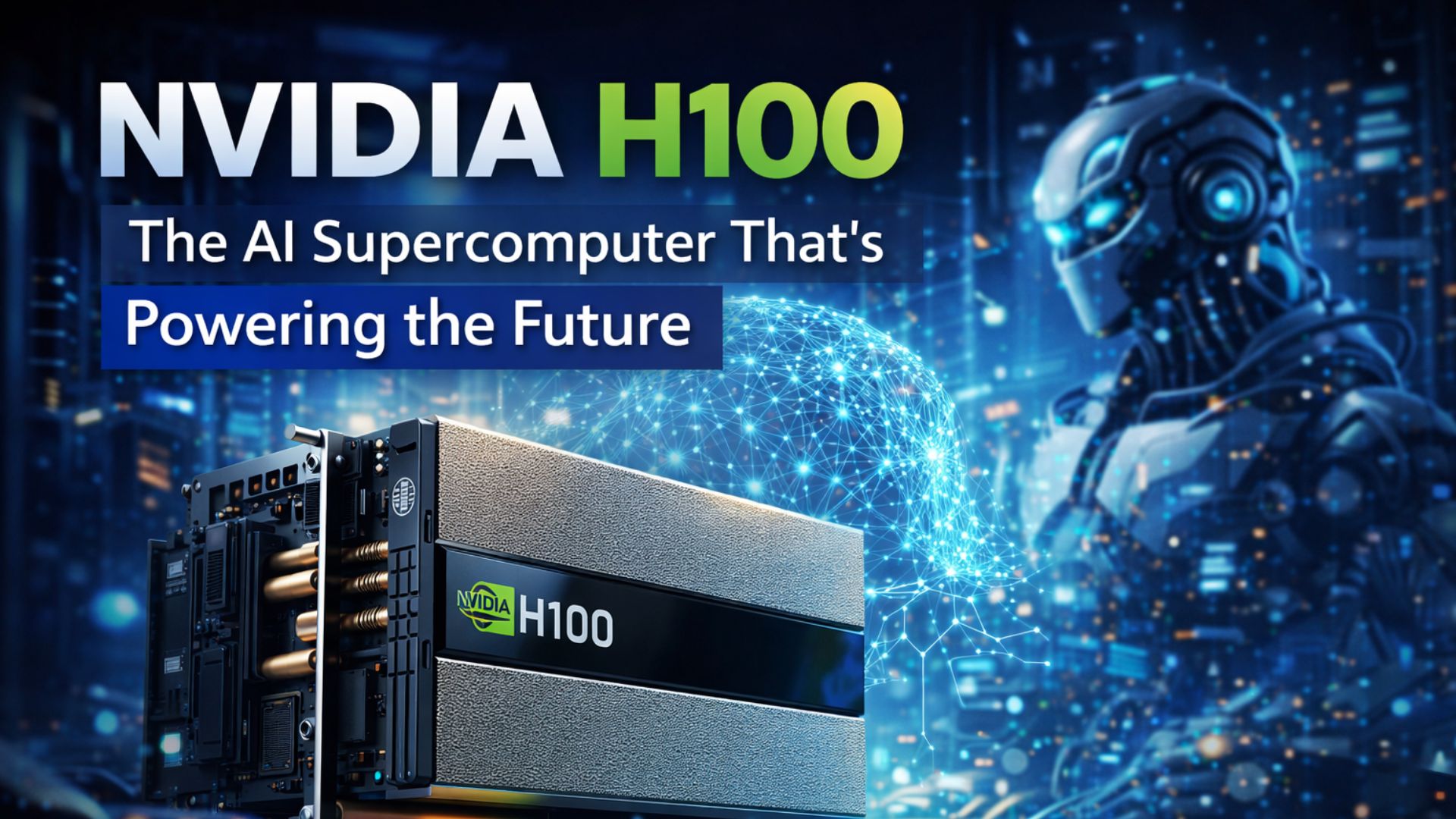
The NVIDIA H100 Tensor Core GPU isn't merely a graphics card. It's a dedicated AI supercomputer on a single chip. Built specifically for large language models, deep learning, and scientific computing, the H100 represents what happens when you design hardware from the ground up for the AI era.
Quick Facts:
-
Announced: March 2022 at GTC
-
Architecture: Hopper (named after computing pioneer Grace Hopper)
-
Manufacturing: TSMC 4N process (custom 4nm)
-
Transistors: 80 billion (yes, billion with a B)
-
Memory: Up to 80GB HBM3
-
Price Range: $30,000-$40,000 per GPU
What Makes H100 So Revolutionary?
The Transformer Engine: AI's Secret Weapon
The most groundbreaking feature isn't just raw power—it's intelligence. The H100 introduces the Transformer Engine, hardware specifically optimized for the transformer architecture that powers models like GPT-4, BERT, and T5.
How it works:
-
Dynamically adjusts precision (FP8, FP16, BF16) during computation
-
9x faster AI training vs previous generation (A100)
-
30x faster inference for large language models
The Numbers That Matter
| Metric | H100 Performance | Improvement vs A100 |
|---|---|---|
| AI Training (FP8) | 2,000 TFLOPS | 6x faster |
| AI Inference (FP8) | 4,000 TFLOPS | 30x faster |
| Memory Bandwidth | 3.35 TB/s | 1.7x faster |
| Interconnect Speed | 900 GB/s (NVLink) | 1.5x faster |
Real Impact: What These Numbers Mean
-
GPT-3 Training: From months to weeks
-
Protein Folding: Days instead of years
-
Weather Prediction: Hours instead of days
Technical Deep Dive: Inside the Beast
Chip Architecture: Engineering Marvel
SM (Streaming Multiprocessor) Revolution:
-
144 SMs (up from 108 in A100)
-
Fourth-gen Tensor Cores with FP8 support
-
New thread block cluster concept
-
Enhanced asynchronous execution
Memory Subsystem:
-
80GB HBM3 memory
-
3.35 TB/s bandwidth
-
50MB L2 cache (2nd generation)
-
Memory compression and encryption acceleration
NVLink 4.0: The Superhighway
-
900 GB/s bidirectional bandwidth
-
18 NVLinks per GPU
-
Forms massive 256-GPU clusters
-
Essential for giant AI models
PCIe 5.0 and DPX Instructions
-
First GPU with PCIe 5.0 support
-
128 GB/s bidirectional CPU-GPU bandwidth
-
New DPX instructions for dynamic programming
-
Accelerates genomics, robotics, and route optimization
Hopper Architecture: More Than Just Numbers
Multi-Instance GPU (MIG) 2.0
The H100 takes GPU partitioning to the next level:
Enhanced Capabilities:
-
Up to 7 secure GPU instances
-
Each with isolated paths through memory
-
Independent clock management
-
Perfect for cloud providers and multi-tenant environments
Use Cases:
-
Cloud GPU sharing
-
Development/testing environments
-
Multiple small model inference
Confidential Computing
In the age of data privacy, H100 introduces:
-
Hardware-based memory encryption
-
Secure GPU virtualization
-
Trusted execution environments
-
Essential for healthcare and financial AI
Fourth-Generation NVSwitch
-
7.2 Tb/s switching capacity
-
Supports 256 GPUs in a single node
-
All-to-all communication patterns
-
Essential for massive model parallel training
Real-World Applications Changing Industries
1. Large Language Models & Generative AI
OpenAI's Reality:
-
Training GPT-4 reportedly used thousands of H100s
-
Inference costs dropped dramatically
-
Enables real-time conversational AI at scale
Enterprise Impact:
-
Custom LLMs for businesses
-
Real-time translation services
-
Code generation and debugging
2. Scientific Discovery
Drug Discovery:
-
NVIDIA BioNeMo: Training on H100s can reduce drug discovery from years to months
-
Protein folding predictions in real-time
-
Molecular dynamics simulations
Climate Science:
-
Earth-2: NVIDIA's digital twin of Earth runs on H100 clusters
-
Hyper-local weather predictions
-
Climate change modeling
3. Autonomous Vehicles
Training at Scale:
-
Processing petabytes of sensor data
-
Real-time neural network training
-
Simulation environments for testing
4. Recommendation Systems
What's Changed:
-
Real-time personalization at massive scale
-
Multi-modal recommendations (text, image, video)
-
30x faster model updates
5. Financial Services
High-Frequency Trading AI:
-
Sub-millisecond inference
-
Fraud detection in real-time
-
Risk analysis on massive portfolios
H100 vs Competition: Who's Winning?
NVIDIA H100 vs AMD MI250X
| Feature | NVIDIA H100 | AMD MI250X |
|---|---|---|
| AI Performance | 2,000 TFLOPS (FP8) | 383 TFLOPS (FP16) |
| Memory Bandwidth | 3.35 TB/s | 3.2 TB/s |
| Transistors | 80 billion | 58.2 billion |
| Software Ecosystem | CUDA, extensive AI stack | ROCm, growing support |
| Transformer Engine | ✅ Yes | ❌ No |
| Price (approx) | $30-40K | $20-25K |
H100 vs Google TPU v4
| Aspect | NVIDIA H100 | Google TPU v4 |
|---|---|---|
| Availability | Commercial sales | Google Cloud only |
| Flexibility | General purpose + AI | AI-optimized only |
| Programming | CUDA/C++ | TensorFlow/JAX |
| Scalability | Thousands of GPUs | Pods of 4096 chips |
| Use Case | Broad AI/ML/HPC | Google services, cloud |
The Software Advantage: CUDA Dominance
NVIDIA's real moat isn't hardware—it's software:
-
4+ million CUDA developers
-
3,000+ GPU-accelerated applications
-
Complete AI stack (RAPIDS, TensorRT, Triton)
-
Enterprise support and certification
Access and Availability: Who Can Get It?
Purchase Options
1. Direct Purchase (DGX Systems)
-
DGX H100: 8x H100 GPUs, $230,000+
-
DGX SuperPOD: Full racks, millions of dollars
-
Lead times: 6-12 months (as of 2024)
2. Cloud Providers
-
AWS: P5 instances (8x H100) - $98.32/hour
-
Azure: ND H100 v5 VMs
-
Google Cloud: A3 VMs (8x H100)
-
Oracle Cloud: OCI Compute H100 instances
3. Server Partners
-
Dell, HPE, Lenovo, Supermicro
-
Custom configurations available
-
Typically $250K+ for full servers
Who's Buying Them?
-
Hyperscalers: Microsoft, Google, AWS (buying tens of thousands)
-
AI Startups: OpenAI, Anthropic, Cohere
-
Research Institutions: National labs, universities
-
Financial Institutions: JPMorgan, Goldman Sachs
-
Automotive: Tesla, Mercedes, Toyota
The Supply Challenge
-
TSMC 4N process capacity limited
-
High demand creating 6-12 month wait times
-
US export restrictions affecting China sales
-
Secondary market prices 2-3x MSRP
Future Implications: Beyond Just Faster AI
Democratizing AI?
The Paradox:
-
H100 makes AI cheaper per computation
-
But upfront costs are prohibitive for most
-
Cloud access helps, but still expensive
-
Creates AI "haves" and "have-nots"
Potential Solutions:
-
Cloud spot instances and sharing
-
Government-subsidized AI access
-
Open-source model efficiency improvements
Next-Generation AI Models
What H100 Enables:
-
Trillion+ parameter models becoming practical
-
Multi-modal AI (text, image, audio, video)
-
Real-time AI applications
-
Personalized AI for everyone
Economic Impact
Job Creation:
-
AI model developers
-
GPU cluster administrators
-
AI application developers
-
Data center construction/operations
Industry Transformation:
-
Pharmaceuticals: Faster drug discovery
-
Finance: Real-time risk analysis
-
Entertainment: AI-generated content
-
Manufacturing: AI-optimized processes
Environmental Considerations
Power Consumption:
-
H100: 700W TDP (up from 400W for A100)
-
Full DGX H100: ~10kW per server
-
Cooling challenges in data centers
-
NVIDIA's focus on efficiency per watt
Green AI Initiatives:
-
FP8 reduces energy consumption
-
Better performance per watt than predecessors
-
Renewable-powered data centers
-
Carbon offset programs
Frequently Asked Questions
Technical Questions
Q: Can I buy a single H100 for my desktop?
A: Technically yes, but practically no. H100 requires specialized servers with high-wattage power supplies, advanced cooling, and specific motherboards. The entry cost for a single H100 system starts around $100,000.
Q: How does H100 compare to gaming GPUs like RTX 4090?
A: Completely different classes. RTX 4090 is optimized for gaming and consumer workloads (65 TFLOPS FP32). H100 is optimized for AI and HPC (2,000 TFLOPS FP8). They're built for entirely different purposes.
Q: What's the difference between H100 PCIe and SXM versions?
A: SXM5: Higher performance (700W), requires NVIDIA's custom board, better for dense computing. PCIe: Lower power (350-450W), standard PCIe slot, more flexible deployment. Performance difference: SXM is ~15-20% faster for AI workloads.
Practical Questions
Q: How long will H100 remain state-of-the-art?
A: NVIDIA typically has a 2-year major release cycle. H200 (successor) is already announced with HBM3e memory. However, H100 will remain relevant for 3-5 years given software optimization and ecosystem development.
Q: Is cloud or on-prem better for H100?
A: Cloud: No upfront cost, scalability, maintenance-free. On-prem: Better long-term cost for heavy usage, data control, customization. Most enterprises use hybrid approaches.
Q: What software is needed to use H100?
A: NVIDIA's complete stack:
-
CUDA 12.0+
-
TensorRT for inference
-
Triton Inference Server
-
RAPIDS for data science
-
Enterprise support available
Business Questions
Q: What's the ROI on H100 investment?
A: For AI-heavy companies:
-
Model training time reduction: 6-9x faster
-
Inference cost reduction: 20-30x cheaper
-
Typically 6-18 month ROI for heavy users
-
Enables new revenue streams (AI services)
Q: Are there alternatives to buying H100?
A: Yes:
-
Cloud instances (pay-per-use)
-
Colocation (rent space in data centers)
-
AI-as-a-Service platforms
-
Older generation GPUs (A100, V100) for less intensive workloads
Q: How do export controls affect availability?
A: US restrictions limit H100 sales to China. NVIDIA created A800 and H800 (reduced performance) for Chinese market. This affects global supply chain and pricing.
Future Outlook
Q: What comes after H100?
A: H200 (announced): HBM3e memory, same architecture. B100 (expected 2025): Next-gen architecture, possibly chiplet design. GB200 (Grace-Blackwell): CPU-GPU superchip.
Q: Will there be consumer versions of H100 technology?
A: Some features trickle down. RTX 5000 series (expected 2025) will likely include some Hopper architecture improvements, especially for AI acceleration in consumer applications.
Q: How does quantum computing affect H100's relevance?
A: Quantum and classical (H100) computing will coexist for decades. H100 handles today's practical AI problems. Quantum will solve specific problems (cryptography, chemistry) but won't replace GPUs for general AI soon.
Conclusion: The Engine of Our AI Future
The NVIDIA H100 isn't just another GPU—it's the foundational technology enabling the next wave of AI innovation. From accelerating scientific discovery to powering the generative AI revolution, H100 represents what happens when hardware is purpose-built for the most demanding computational challenges of our time.
Key Takeaways:
-
Transformer Engine is revolutionary - Specialized hardware for the AI models that matter
-
Access is democratizing through cloud - While expensive, cloud options make H100 power available to startups and researchers
-
Software ecosystem is NVIDIA's moat - CUDA and AI tools are as important as the hardware
-
This is just the beginning - H100 enables AI applications we haven't even imagined yet
What to Watch Next:
-
H200 rollout in 2024 with HBM3e memory
-
Competitive responses from AMD, Intel, and custom silicon
-
AI model efficiency improvements reducing compute requirements
-
Edge AI deployments bringing H100-like capabilities to devices
The race for AI supremacy isn't just about algorithms and data—it's about compute. And right now, with the H100, NVIDIA isn't just winning the race; they're defining the track everyone else has to run on.
Whether you're a researcher pushing the boundaries of science, a business leader transforming your industry with AI, or just someone fascinated by technological progress—the H100 represents a pivotal moment in computing history. The future isn't just coming; it's being powered by 80 billion transistors working in perfect harmony.