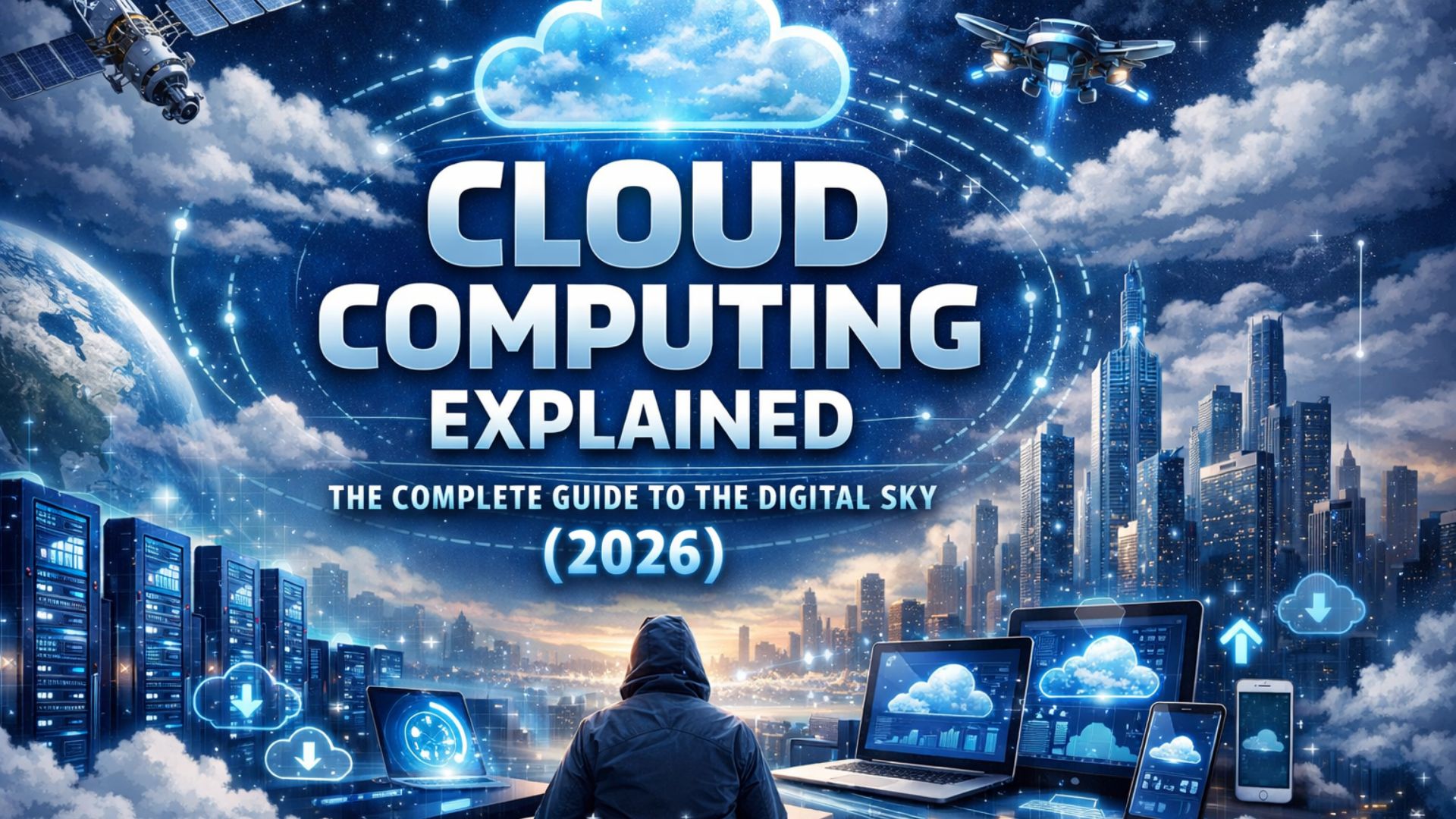
As we stand in 2026, cloud computing has evolved from a disruptive technology to the foundational fabric of our digital existence. What began as a cost-saving measure for IT infrastructure has transformed into an intelligent, distributed, and immersive computing environment that powers everything from quantum research labs to the augmented reality interfaces in our daily lives.
This comprehensive guide explores the state of cloud computing in 2026—where we've been, where we are, and where we're heading. We'll examine how AI-native architectures, quantum cloud services, and decentralized computing paradigms are reshaping what "the cloud" even means.
Part 1: The State of Cloud Computing in 2026
Current Landscape: Beyond Hybrid to Unified Computing
The traditional distinctions between public, private, and hybrid cloud have dissolved into what industry leaders now call "Unified Computing Fabric"—a seamless integration of edge devices, private infrastructure, public cloud services, and specialized processors (quantum, neuromorphic, and photonic) that appears as a single, logical computing environment.
Key 2026 Trends:
-
AI-First Architecture: Cloud infrastructure is now designed primarily for AI workloads, with traditional computing as a secondary consideration
-
Autonomous Cloud Management: Self-optimizing, self-healing systems managed by AI ops
-
Quantum-Enhanced Services: Classical cloud services augmented with quantum processing units (QPUs)
-
Sustainable Computing Mandates: Carbon-negative cloud operations becoming standard
-
Sovereign Cloud Ecosystems: Regional cloud infrastructures complying with diverse data governance models
Market Evolution: The Big Five and Specialized Players
While AWS, Microsoft Azure, and Google Cloud continue to dominate, 2026 has seen the emergence of "The Big Five" cloud providers with the addition of:
-
AWS: Still the market leader but now focused on AI and quantum services
-
Azure: Dominant in enterprise AI integration and mixed reality platforms
-
Google Cloud: Leader in AI research infrastructure and sustainable computing
-
Ocean Protocol: The decentralized cloud leader, specializing in privacy-preserving AI
-
Huawei Cloud: Leading in Asia-Pacific with advanced edge computing integration
Emerging Niches:
-
Specialized AI Clouds (Cerebras, SambaNova)
-
Bio-Compute Clouds for healthcare and synthetic biology
-
Sovereign AI Clouds for government and regulated industries
Part 2: Service Models Evolved: The 2026 Stack
1. Intelligence as a Service (IaaS 2.0)
The traditional IaaS model has evolved into AI-optimized infrastructure where every component is intelligent and self-managing.
2026 Examples:
-
AWS Nitro AI: Hyper-optimized AI inference and training instances
-
Azure Maia: Custom AI accelerator chips available as cloud service
-
Google Trillium: Sixth-generation TPU clusters with integrated quantum simulators
2. Platform as an AI Partner (PaaS++)
Modern PaaS platforms are now AI co-development environments that understand application intent and autonomously optimize performance, security, and cost.
2026 Capabilities:
-
Intent-Based Deployment: Describe what you want your application to do, not how to build it
-
Autonomous Scaling: Real-time, predictive scaling based on AI analysis of usage patterns
-
Cross-Cloud Portability: AI-managed deployment across multiple providers for optimal performance/cost balance
3. Autonomous Software Ecosystems (SaaS 3.0)
SaaS applications in 2026 are not just cloud-hosted—they're autonomous, self-improving systems that adapt to individual user needs and organizational contexts.
Characteristics:
-
Personalized User Experiences: Each user interacts with a uniquely adapted version of the software
-
Predictive Functionality: Features appear before users realize they need them
-
Inter-Application Intelligence: SaaS applications communicate and collaborate autonomously
4. New Model: Consciousness as a Service (CaaS)
An emerging category where cloud platforms provide varying levels of artificial general intelligence capabilities.
Early Implementations:
-
Google's Gemini Ultra Cloud: Reasoning engines for complex problem solving
-
OpenAI's O3 Platform: Advanced reasoning systems available via API
-
Anthropic's Constitutional AI Cloud: Aligned AI systems for sensitive applications
Part 3: Technological Breakthroughs Defining 2026 Cloud
1. The Quantum-Cloud Continuum
Quantum computing is no longer experimental but an integrated part of the cloud stack.
2026 Quantum Cloud Services:
-
Quantum-Enhanced Optimization: Solving logistics, supply chain, and financial modeling problems
-
Quantum Machine Learning: Accelerated AI training on specialized quantum neural networks
-
Cryptography Services: Quantum-resistant encryption and quantum key distribution as standard services
Key Players:
-
IBM Quantum Network - Most extensive quantum cloud ecosystem
-
Google Quantum AI - Integrated with Google Cloud services
-
Azure Quantum - Full-stack quantum development environment
2. Neuromorphic Computing Clouds
Specialized hardware that mimics the human brain's neural structure has become commercially available through cloud providers.
Applications:
-
Real-time sensor processing for autonomous vehicles
-
Energy-efficient AI at massive scale
-
Brain-computer interface backends
3. Photonic Computing Infrastructure
Light-based computing has moved from labs to production environments, offering unprecedented speed for specific workloads.
4. Sovereign AI and Privacy-Preserving Computation
Federated learning, homomorphic encryption, and secure multi-party computation have become standard features, enabling data analysis without exposing raw data.
2026 Standard Practices:
-
Differential Privacy by Default: All major cloud services implement it
-
Federated Learning Orchestration: Training AI across decentralized data sources
-
Confidential Computing: Hardware-enforced data isolation even from cloud providers
Part 4: Industry-Specific Cloud Transformations
Healthcare: The Bio-Digital Twin Cloud
Hospitals and research institutions now run patient-specific digital twins in secure cloud environments, enabling personalized treatment simulations and drug response predictions.
Manufacturing: The Industrial Metaverse Cloud
Complete digital replicas of factories, supply chains, and products enable simulation, optimization, and remote operation of physical industrial systems.
Finance: The Autonomous Regulatory Cloud
Financial institutions operate in cloud environments that automatically ensure compliance with global regulations through real-time monitoring and adaptive controls.
Research: The Collaborative Discovery Cloud
Global research projects share petabytes of data and exascale computing resources through specialized research clouds like CERN's Science Cloud and NASA's Earth Science Cloud.
Part 5: Sustainability and Ethics in 2026 Cloud
The Carbon-Negative Imperative
All major cloud providers now operate at carbon-negative levels through:
-
Advanced renewable energy integration
-
AI-optimized data center cooling and operations
-
Direct air capture technologies integrated into data centers
-
Circular economy approaches to hardware lifecycle
Ethical AI and Governance
Cloud providers have implemented sophisticated ethical frameworks:
-
AI Constitution Services: Ensuring AI alignment with human values
-
Bias Detection and Mitigation: Automated systems for fairness auditing
-
Transparency Portals: Real-time monitoring of AI decision-making processes
Digital Sovereignty and Data Governance
2026 sees diverse governance models coexisting:
-
EU's Gaia-X: Federated data infrastructure
-
China's Sovereign AI Cloud: Complete domestic control
-
African Union's Pan-African Cloud: Continental data sovereignty
Part 6: Getting Started with 2026 Cloud Technologies
For Developers: The New Toolkit
-
AI-Assisted Development Platforms:
-
GitHub Copilot X - Full development lifecycle AI assistance
-
Amazon CodeWhisperer - Cloud-optimized AI coding companion
-
-
Quantum Development Kits:
For Businesses: Migration to 2026 Cloud
Strategic Considerations:
-
AI Readiness Assessment: Evaluating existing infrastructure for AI integration
-
Quantum Relevance Analysis: Identifying use cases for quantum enhancement
-
Sovereignty Compliance: Navigating regional data governance requirements
Implementation Roadmap:
-
Intelligent Assessment Phase: AI-powered analysis of current infrastructure
-
Phased Modernization: Progressive integration of AI-native services
-
Skills Transformation: Upskilling teams for AI-augmented cloud management
Part 7: The Future Beyond 2026
Emerging Trends on the Horizon
-
Biological Computing Interfaces: Direct neural integration with cloud resources
-
Autonomous Cloud Ecosystems: Self-forming, self-managing distributed computing fabrics
-
Interplanetary Cloud Architectures: Extending cloud infrastructure to space-based computing
Long-Term Predictions
-
The Dissolution of "Cloud" as a Concept: Computing will become like electricity—ubiquitous, invisible, and essential
-
Ambient Intelligence: Cloud-powered AI will become an invisible background layer of daily life
-
Democratized Supercomputing: Access to exascale computing will become as common as smartphone ownership
Essential Resources and Further Reading
Key Organizations and Standards Bodies
-
Cloud Native Computing Foundation - Cloud native technologies
-
IEEE Cloud Computing - Standards and research
-
The Green Grid - Data center sustainability
Research and Thought Leadership
Learning Platforms
-
Cloud Academy - Hands-on cloud training
Frequently Asked Questions (2026 Edition)
General Cloud Computing
Q1: Is cloud computing still relevant with edge computing and AI everywhere?
Absolutely. Rather than being replaced, cloud computing has evolved into the "center" of a distributed computing continuum. The cloud now provides coordination, training, and complex processing for edge devices, while edge handles real-time, local operations. They work synergistically in what's now called the "Cloud-Edge Continuum."
Q2: How much has cloud computing changed since 2020?
The transformation has been profound:
-
2020: Cloud was primarily about cost savings and scalability
-
2023: Focus shifted to AI integration and hybrid deployments
-
2026: Cloud is now an intelligent, autonomous fabric integrating quantum, neuromorphic, and traditional computing with AI-native architecture
Q3: Are companies still doing "cloud migrations" in 2026?
The concept has evolved. Instead of simple "lift-and-shift" migrations, organizations now undertake "Intelligent Transformation Journeys" where AI analyzes their entire digital estate and recommends an optimal blend of edge, private infrastructure, public cloud, and specialized processors.
Security and Privacy
Q4: Is data in the cloud more secure than on-premises in 2026?
Generally, yes—but with important caveats. Major cloud providers invest billions in security that most organizations can't match. However, the attack surface has expanded with more connected services. The key is proper configuration and using the advanced security tools now built into cloud platforms, like AI-powered threat detection and automated response systems.
Q5: How do privacy regulations like GDPR affect cloud computing in 2026?
Privacy regulations have become more sophisticated and globally aligned. Cloud providers now offer:
-
Regulation-aware data management: Automatic compliance with regional regulations
-
Privacy-preserving computation: Technologies like homomorphic encryption as standard features
-
Sovereign cloud options: Isolated regions with specific compliance guarantees
Q6: What is "confidential computing" and why is it important?
Confidential computing ensures data is encrypted not just at rest and in transit, but during processing. Hardware-enforced trusted execution environments prevent anyone—including cloud provider employees—from accessing data while it's being processed. This has become standard for sensitive workloads in finance, healthcare, and government.
Cost and Economics
Q7: Is cloud computing still cost-effective compared to on-premises?
The economics have shifted. While basic computing can sometimes be cheaper on-premises, the total value of cloud services now includes:
-
Integrated AI capabilities
-
Built-in security and compliance
-
Access to quantum and specialized processors
-
Sustainability advantages (carbon-negative operations)
Most organizations find the innovation velocity and capability access justify the costs.
Q8: How has cloud pricing evolved since the early 2020s?
2026 pricing models are more sophisticated:
-
AI-optimized pricing: Costs tied to business outcomes rather than raw resources
-
Sustainability incentives: Discounts for carbon-aware scheduling
-
Quantum compute credits: Separate pricing for quantum-enhanced processing
-
Predictive billing: AI forecasts costs and suggests optimizations
Q9: What percentage of IT spending is on cloud today?
According to recent Gartner reports, cloud spending now represents approximately 65-70% of total enterprise IT spending for most organizations, up from about 20% in 2020. The remaining on-premises spending is typically for specialized legacy systems or sovereign requirements.
Technical Implementation
Q10: What programming languages dominate cloud development in 2026?
The landscape has diversified:
-
Python: Still dominant for AI/ML workloads (≈35% of cloud code)
-
Rust: Growing rapidly for performance-critical cloud services (≈25%)
-
TypeScript: Leading for frontend and full-stack applications (≈20%)
-
Quantum languages: Q#, Qiskit, and Cirq for quantum-enhanced applications
-
AI-assisted low-code: Visual development with AI generating optimized backend code
Q11: How do containers and serverless compare in 2026 usage?
They've converged into a continuum:
-
Containers: Used for complex, stateful applications needing fine-grained control
-
Serverless: Dominant for event-driven, stateless functions and AI inference endpoints
-
Containerless: A new paradigm where developers describe intent and AI orchestrates optimal execution without specifying containers or functions
Q12: What is "AI-native" cloud architecture?
AI-native means:
-
AI manages infrastructure autonomously
-
All services have built-in intelligence
-
Development tools understand intent, not just commands
-
Resources are provisioned based on predicted need, not current demand
-
Security is proactive and adaptive, not rule-based
Industry-Specific
Q13: Which industries have been most transformed by cloud computing?
Healthcare: Cloud-enabled personalized medicine and global research collaboration
Manufacturing: Digital twins and autonomous supply chains
Finance: Real-time risk analysis and regulatory compliance automation
Media: AI-generated and personalized content at scale
Research: Democratized access to supercomputing-class resources
Q14: How has cloud computing affected small businesses differently than enterprises?
Small businesses now have access to capabilities previously only available to Fortune 500 companies:
-
Enterprise-grade AI and analytics
-
Global-scale infrastructure
-
Advanced security tools
The playing field has leveled significantly, though the complexity of choosing and managing these services remains a challenge.
Future Outlook
Q15: What will replace cloud computing?
Nothing will "replace" it in the traditional sense. Cloud computing is evolving into ambient computing—an intelligent, invisible layer that powers everything. The next evolution is likely the integration of biological and digital systems, with cloud infrastructure serving as the bridge.
Q16: When will quantum computing make traditional cloud computing obsolete?
Never. Quantum computing will augment rather than replace classical cloud computing. Specific problems will be solved on quantum processors, but the vast majority of computing tasks will remain more efficient on classical systems. The future is hybrid quantum-classical cloud infrastructure.
Q17: How will cloud computing evolve in the next 5 years (toward 2030)?
We expect:
-
Complete AI autonomy: Self-managing, self-optimizing cloud ecosystems
-
Biology-cloud integration: Direct interfaces between biological systems and cloud AI
-
Space-based cloud nodes: Low-orbit data centers for global latency reduction
-
Conscious AI services: Cloud-based general intelligence available as utility
-
Energy-positive data centers: Clouds that generate more energy than they consume
Conclusion: The Cloud is Now the Ground
As we look at cloud computing in 2026, the most profound realization is that "the cloud" is no longer somewhere else—it's everywhere. It's the intelligent layer that connects our devices, powers our AI assistants, accelerates our research, and protects our data. The sky of computing has become the ground on which we build our digital future.
The journey from centralized mainframes to distributed personal computers to centralized clouds to distributed intelligent computing represents not a circle but a spiral—each iteration incorporating the best of previous paradigms while transcending their limitations.
For individuals, businesses, and societies, understanding and leveraging cloud computing is no longer optional. It has become as fundamental as literacy in the digital age. The question for 2026 and beyond is not whether to use the cloud, but how to harness its evolving capabilities to create value, solve problems, and build a better future.
The cloud has ceased to be a destination and has become the journey itself—constantly evolving, expanding, and elevating what's possible in our connected world.